
Battle of Austerlitz monuments, their participants, and their victims are commemorated not only across the battlefield but also by many different memorials, plaques, and larger structures in the wider area. Come and discover them.
Obelisk in Denisovy sady
The obelisk in Denisovy sady is perhaps the most striking reminder of the Napoleonic Wars in Brno. It was erected to commemorate the victorious end of the Napoleonic Wars in Europe in 1815. The obelisk, known as the Peace Monument, was ceremonially unveiled on 4 October 1818 in the main part of the newly established Františkov Park. The design was created by Alois Ludwig Pichl (1782–1856), court architect to the Archdukes of Modena-Este. The marble work was executed by sculptor Josef Miesel. This classical monument has the shape of a four-sided pyramid, with each corner guarded by a set of gilded lions. Massive iron chains encircle the structure.
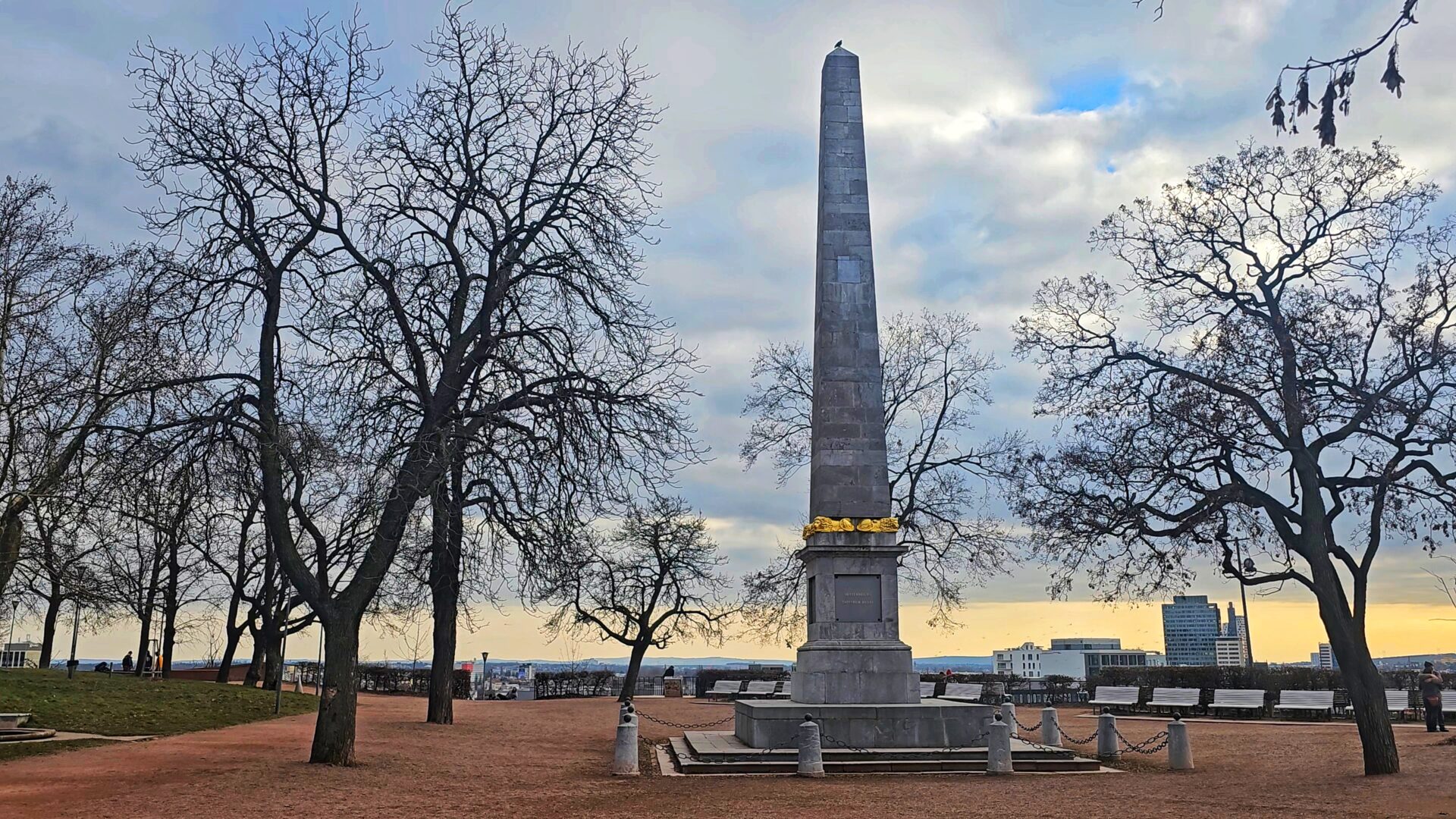
The unveiling was a major social event attended by Austrian Crown Prince Ferdinand, later Emperor Ferdinand V the Benign, who made his first public appearance there. Also present was a direct participant in the Battle of Austerlitz, Prince Jan I of Liechtenstein, commander of the Austro‑Russian cavalry at Slavkov. He was the one who, after the battle, met Napoleon at the Old Post, where he had been sent by Austrian Emperor Francis I. Today, this monument serves as a visual terminus for Husova Street.
The Cairn of Peace Memorial
The dominant feature and natural center of the protected heritage zone of the Slavkov battlefield is the Cairn of Peace Memorial (Mohyla míru) near the village of Prace. It was built according to the vision of clergyman and educator Alois Slovák to honor the victims of the Battle of Austerlitz between 1910 and 1912.
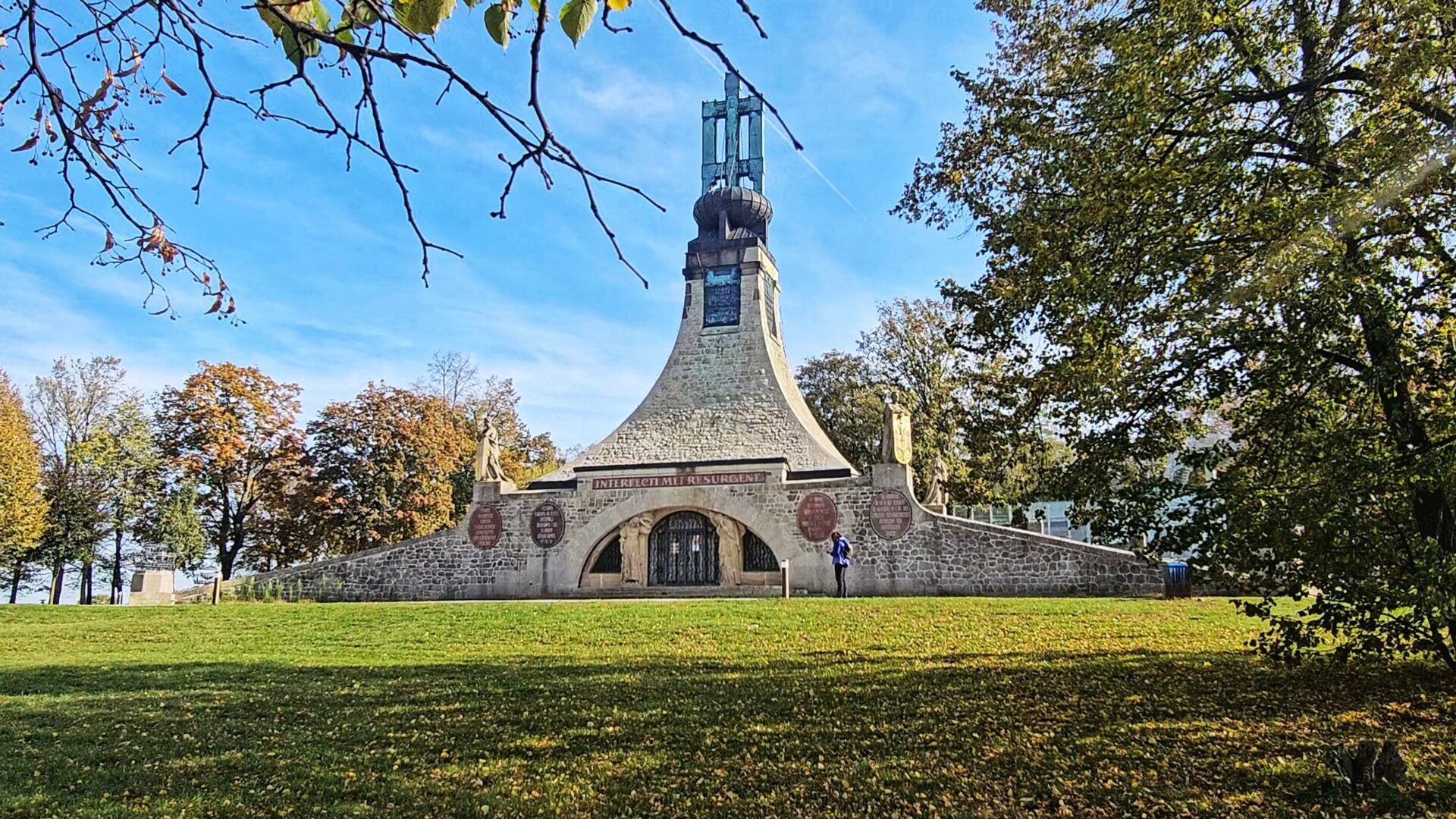
The building is executed in the Art Nouveau style and evokes an Old Slavic burial mound. Constructed from quarry stone, it takes the form of a truncated four‑sided pyramid rising over 26 meters. At the top stands a 10‑meter copper early‑Christian cross resting on a globe. On the corners are four shield‑bearers by sculptor Čeňek Vosmík, their shields symbolizing France, Austria, Russia, and Moravia, where the battle took place. Inside is a chapel serving as a place of piety. In the ossuary — the charnel house — rest remains found across the Slavkov battlefield.
The chapel is renowned for its acoustics: a whisper in one corner can be heard in the opposite corner at the same volume.
Museum
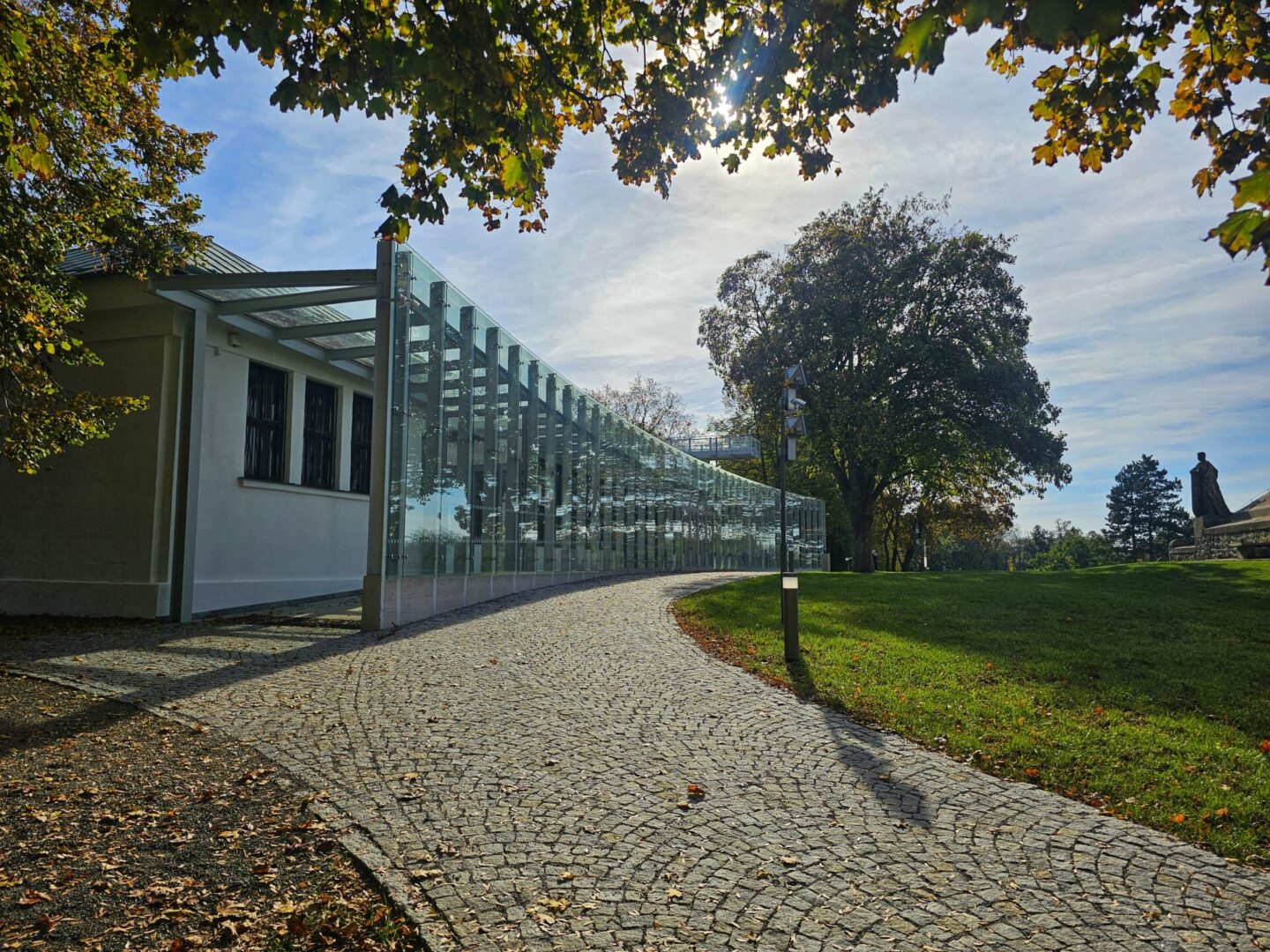
Right next to the Peace Mound stands a museum first opened in the 1920s. The latest reconstruction with a glass curtain‑wall addition was completed in 2024. Inside, you’ll find an exhibition about the battle and the construction of the Cairn of Peace Memorial itself.
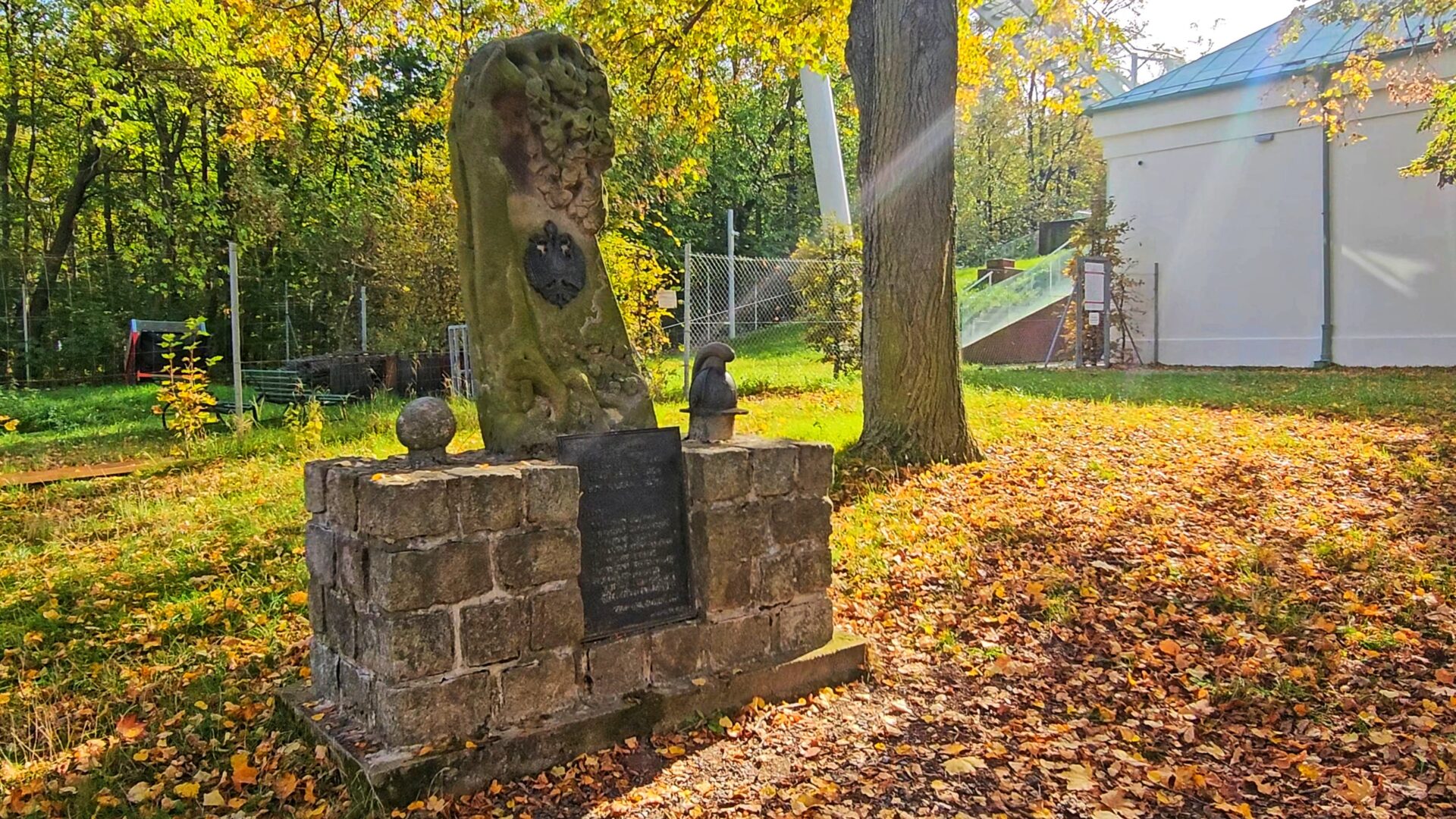
Monument to Major General František Jirčík and the Infantry Brigade
Beneath the trees by the museum is a monument to Austrian Major General of Czech origin František Jirčík (Jurczik). He and his brigade fought within the 4th Allied mixed column in the defense of the Pratzen Heights. Many of his men fell, and Jirčík himself was gravely wounded. He died of his wounds three weeks later in Uherské Hradiště — the only Austrian general to die as a result of this battle. The monument was unveiled in 1995 by members of the historic Austrian Kaiser regiment unit.
Memorial trees and an Austrian field gun
In the Cairn of Peace Memorial grounds, four memorial trees were planted: a linden honoring initiator Alois Slovák, a French oak, a Russian birch, and an Austrian beech (2002–2005). At the corner of the museum, admire a replica Austrian 3‑pounder field gun of the Liechtenstein pattern, used by the Austrian army from 1753.
Reconciliation Monument
The Reconciliation Monument is not directly on the Pratzen Heights; you’ll find it on the right side of the road exiting Prace toward the heights. Its form references the nearby mound and is supplemented with quotes to think about. It was built by the municipality in 2005 for the 200th anniversary of the Battle of Austerlitz (bitva u Slavkova).
Memorial at Žuráň
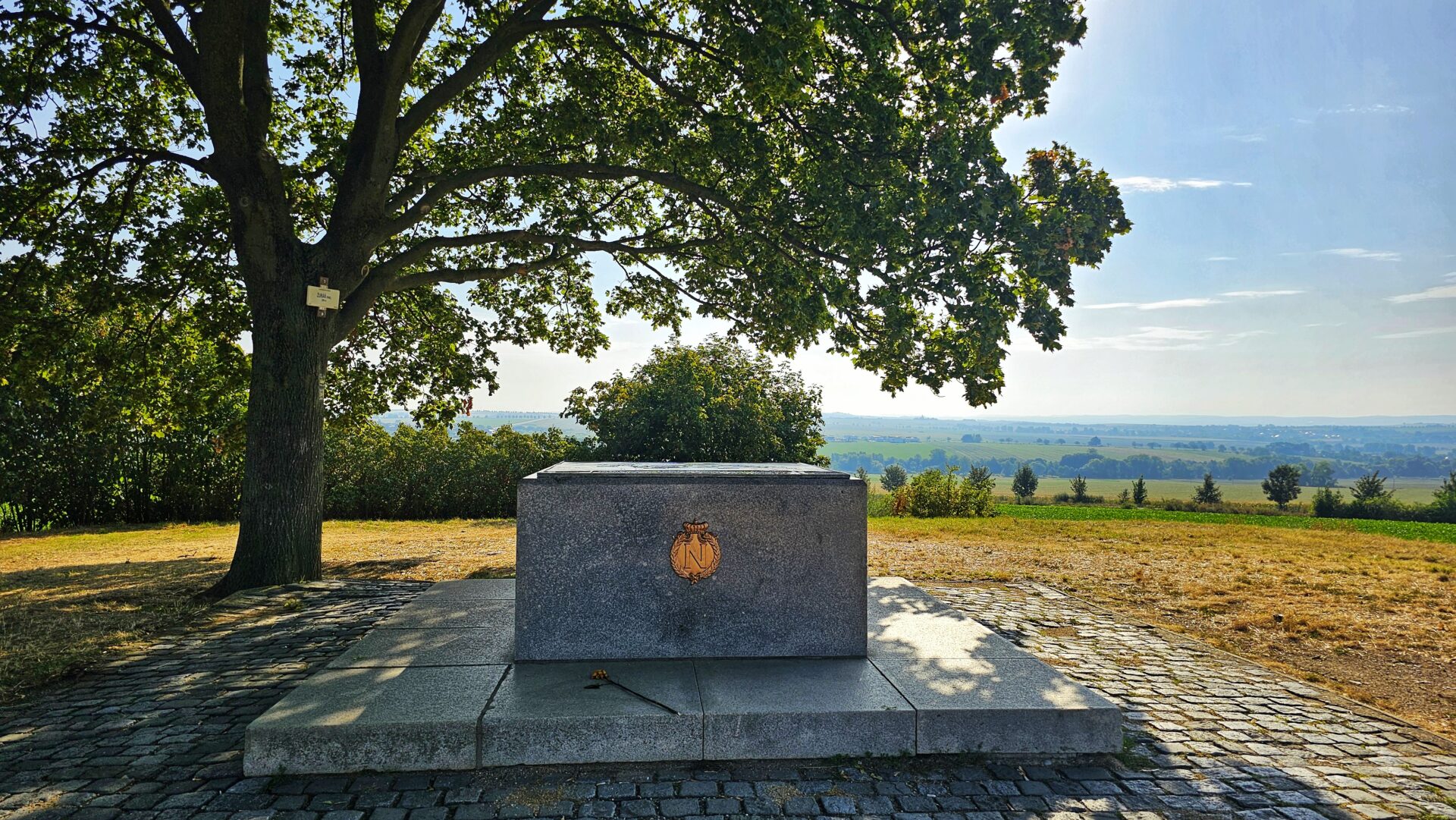
The Žuráň rise, within the cadastral area of Podolí, is visible from afar. The summit is not a natural hill but an artificially heaped burial mound from the Migration Period. Here stood Napoleon Bonaparte’s command post, from which he ordered the attack on the Pratzen Heights.
Today, beneath the trees, you will find a granite block with a relief battle map showing the deployment of forces at 7 a.m. on 2 December 1805. On its sides is a quotation from Napoleon’s famous proclamation after the battle, in French and Czech: “Soldiers! My nation will welcome you with joy, and it is enough to say: I was at the Battle of Slavkov, and the answer will be: behold, a hero.” The memorial was designed by architect Vojtěch Kerhart.
Graves and memorials to the fallen
Across the battlefield, many memorials commemorate both military and civilian victims of the battle. They are scattered throughout the area. Some arose soon after the battle, but most date from the late 20th and early 21st centuries.
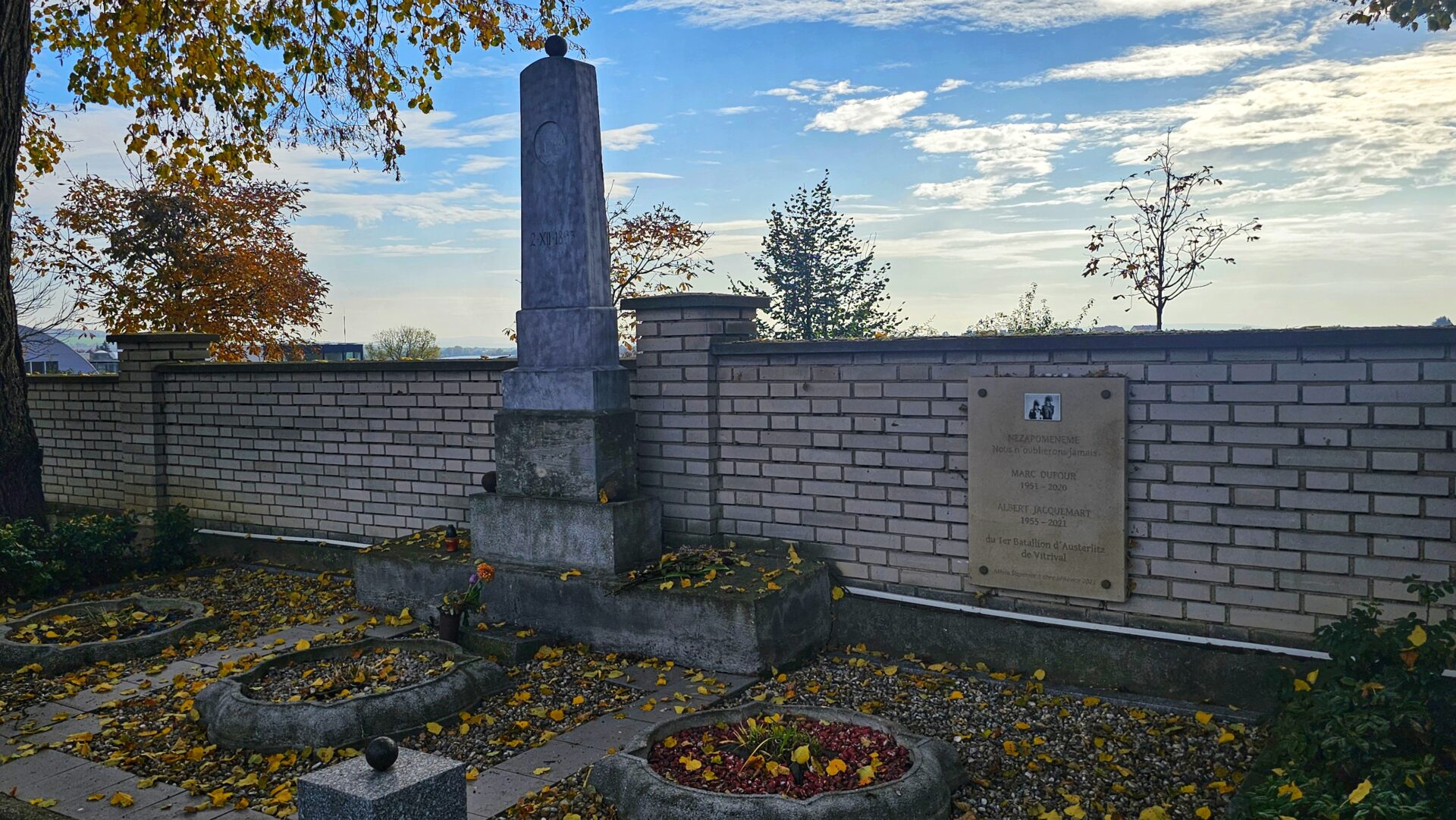
Grave of French soldiers in the Šlapanice cemetery
You’ll find the grave just beyond the gate by the southwest wall. It contains the remains of French soldiers who died in the local hospital, transferred there from the so‑called Krchůvek. Established in the 1960s, the grave bears the initial “N,” the date 2 XII 1805, and symbolic cannonballs. A nearby plaque honors promoters of the Napoleonic tradition.
Mass grave of fallen Russians in Tvarožná
In Tvarožná, on the slope beside the stairway to the church of St. Nicholas, stands a monument with a black granite plaque and Latin and Orthodox crosses. The inscription reads: “At this place lies a common grave of Russian soldiers who fell on 2 December 1805 in the fighting below Santon. Honor to their memory.” The monument was unveiled in 2004 on the eve of the 199th anniversary of the Battle of Austerlitz, in the presence of the Consul General of the Russian Federation in Brno, V. I. Sibilev.
Memorial to the victims of the Napoleonic Wars and a French cannon replica
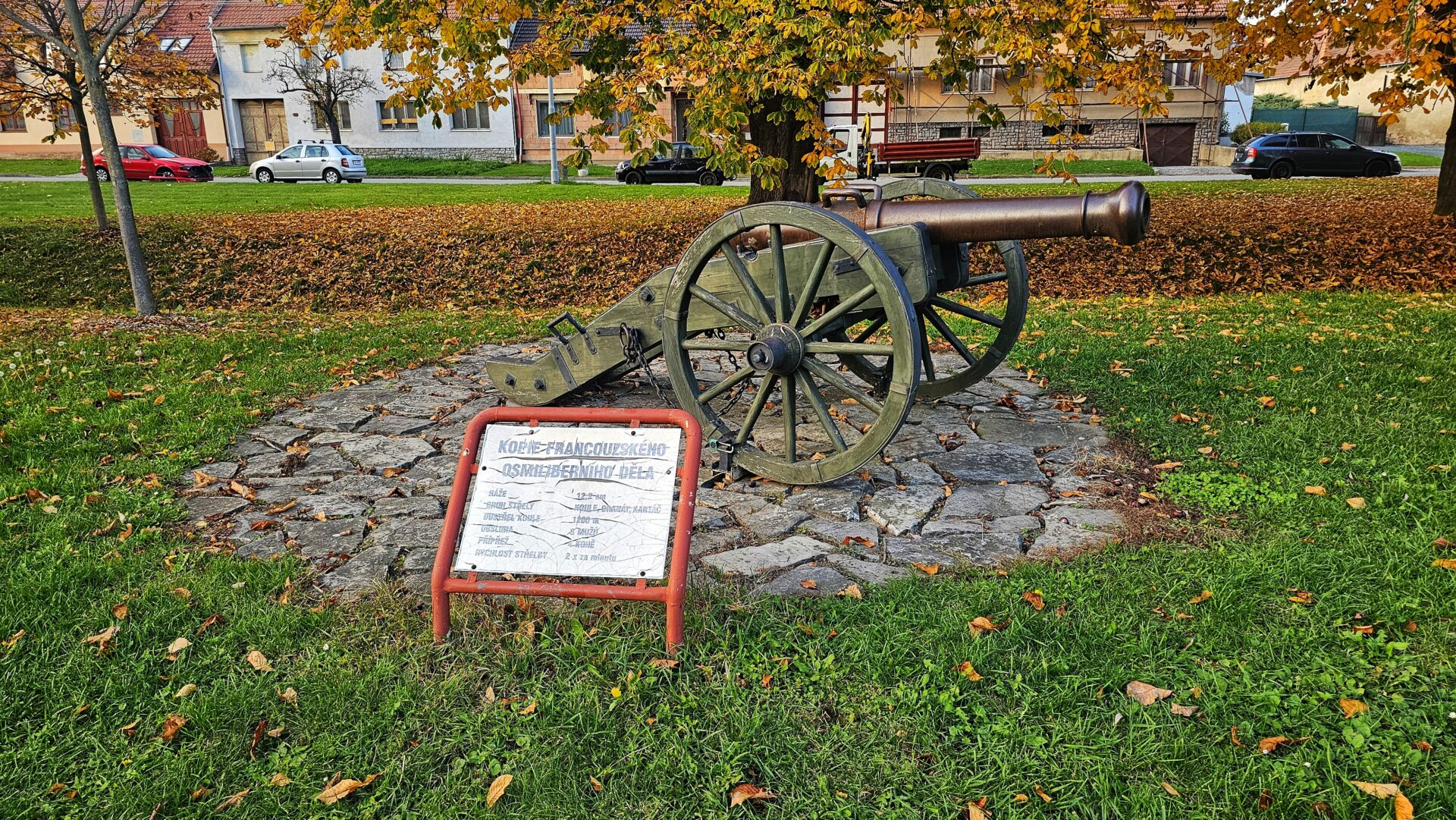
This memorial is a polished granite plaque on a concrete plinth in front of the Tvarožná municipal office, installed in 1993, next to the monument to villagers fallen in World War I. Its inscription reads: “In memory of the victims of the Battle of the Three Emperors, 2 December 1805,” with two crossed sabers. Nearby stands a replica 8‑pounder Gribeauval cannon of the type used by French artillery in the Battle of Austerlitz. Originally the cannon was placed on the santon hill in 1988, it suffered frequent vandalism; after a 2009 overhaul, it was moved to the village green. The cannon weighs 360 kg and the barrel length is 180 cm.
Cross on a mass grave
A mass grave of about 800 Russian soldiers who fell in the Battle of Austerlitz is located in Prace. It is marked by a cross on the bank of the lower Prace pond, in the Na Nivkách locality. The 19th‑century cross bears the inscription “For the honor and glory of the nation, 1805.”
Memorial to the fallen of the Battle of Austerlitz
Another mass grave stands near Křenovice, by the road connecting Křenovice and Prace, in a place called Krchůvek. A simple monument bears a white plaque reading: “The final rest of the heroes of the Slavkov battle, 1805.” Nearby is also a memorial to cholera victims from 1836 and 1866.
Memorial to the fallen at Santon
Along the path from Tvarožná to the summit of Santon with the Chapel of Our Lady of the Snows stands a small white memorial. It honors all the unnamed soldiers and civilians who fell in the Slavkov battle. The inscription reads: “Blessed are those who died in the Lord, 2 December 1805.”
Memorial to the victims of the Battle of Austerlitz
In Kobylnice, on U Mlýna Street, a large stone bears a plaque inscribed: “N Austerlitz 2.12.1805 In memory of the French soldiers of the 18th Line Infantry Regiment; 4th Army Corps of Marshal Soult; 3rd Infantry Division, 2nd Brigade.”
Pietà
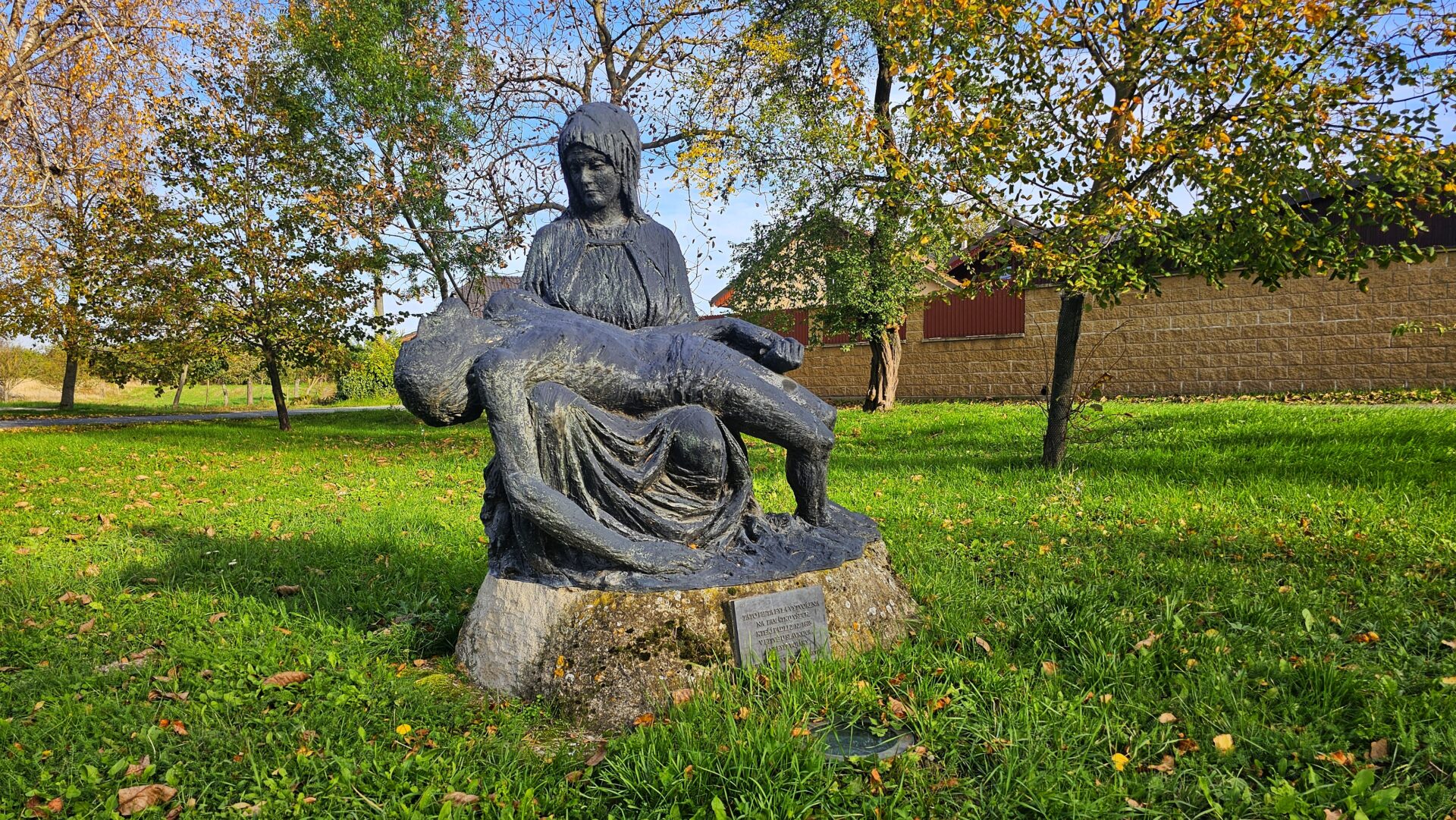
The Pietà stands in Újezd u Brna, in a small park opposite the Rychanovský Pond. It depicts a woman holding a dead man in her arms. The plaque reads: “This Pietà was created in memory of all who fell on 2 December 1805 in the Battle of Austerlitz and were not soldiers.” The sculpture (2009) is by Nikos Armutidis.
Monument to the victims of the Battle of the Three Emperors
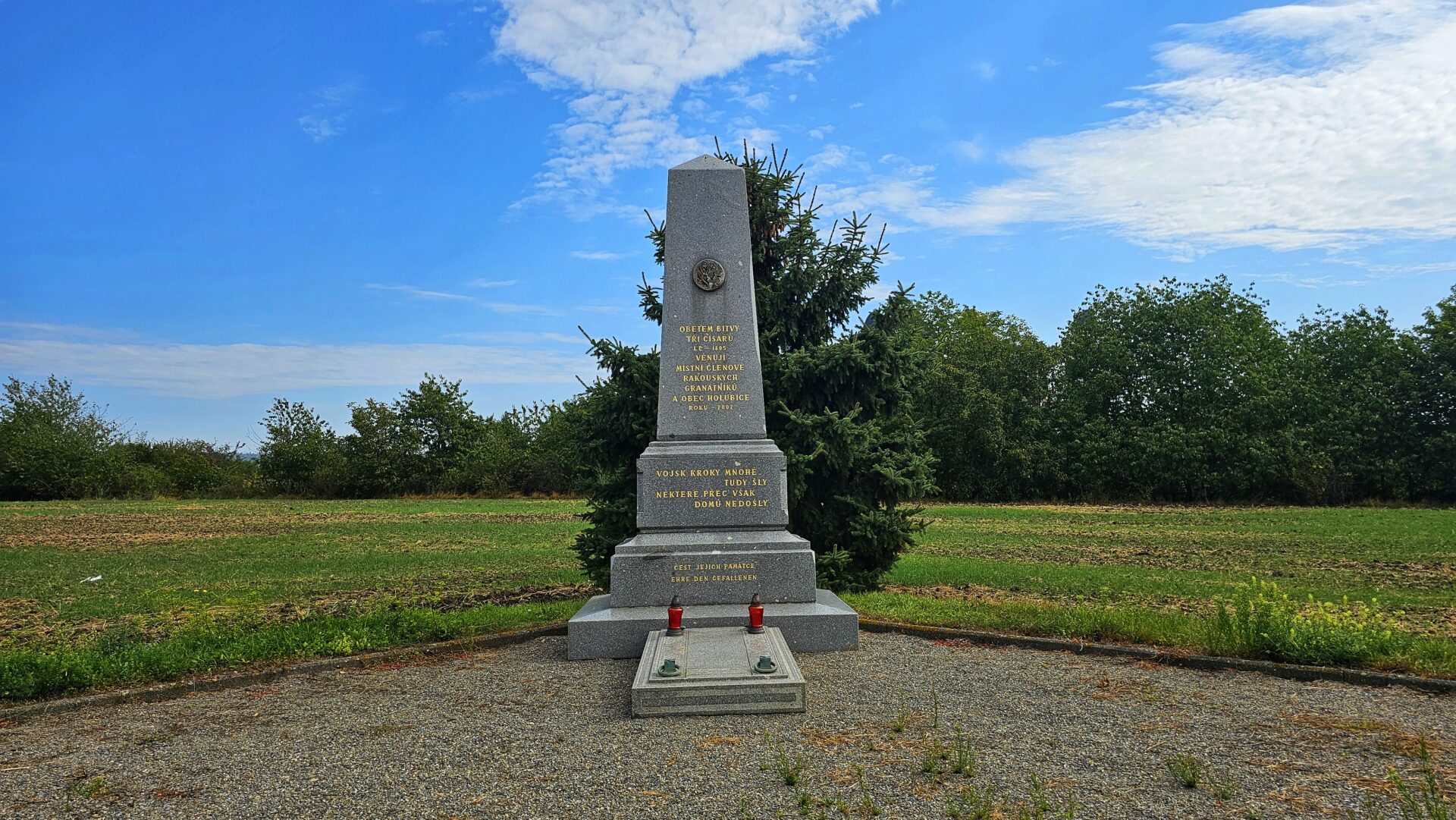
This granite monument stands just right of the turn to Holubice from the Brno–Olomouc road. It was built and unveiled in 2002 by local members of the Austrian grenadiers of the Kaiser infantry regiment together with the municipality of Holubice. The inscriptions read: “To the victims of the Battle of the Three Emperors, AD 1805, dedicated by local Austrian grenadiers and the municipality of Holubice, 2002. Many the steps of armies trod here, yet some did not return home. Honor to their memory.”
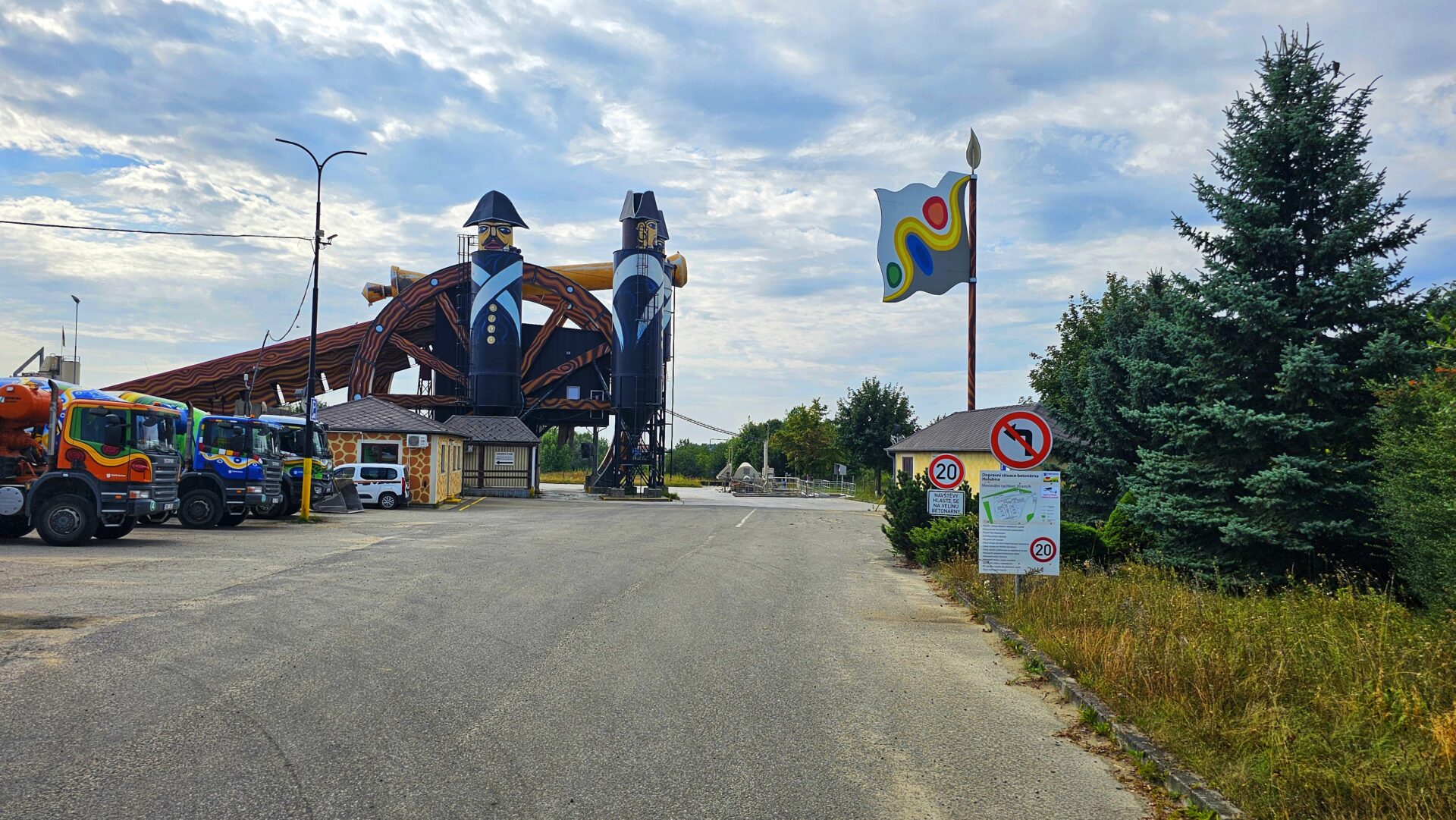
The battle is also recalled by the silos at the Zapa beton plant near the monument, stylized as French soldiers guarding a cannon.
Chapel of Our Lady of the Snows
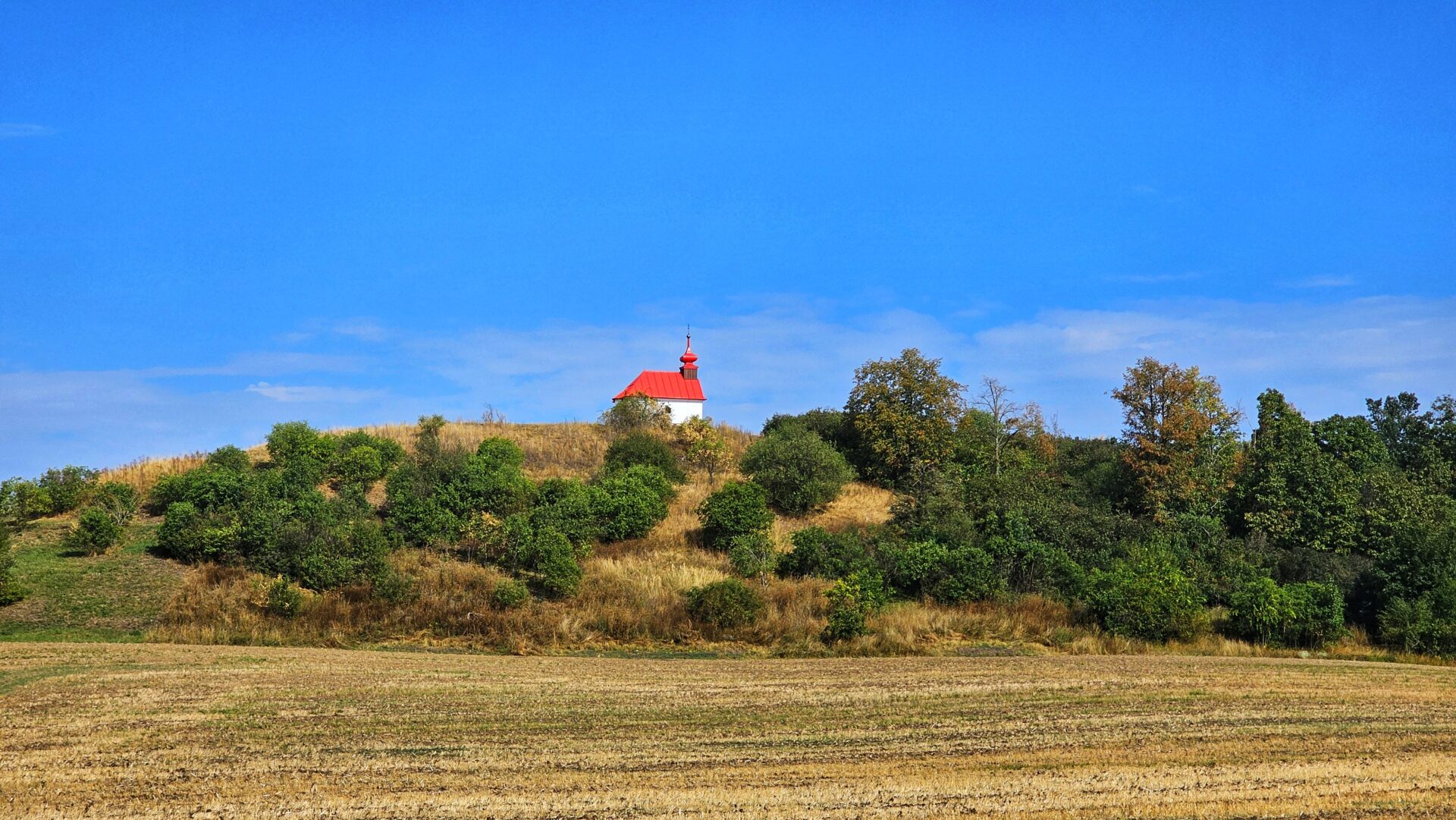
From afar you can see the red roof of this pilgrimage chapel on the summit of Santon near Tvarožná. The chapel was built on the foundations of the original partly wooden 1700 chapel, demolished by French troops while fortifying Santon in 1805. A few years after the battle, it was rebuilt on the original site, with full restoration completed in 1832. On the northwest side are plaques to French Generals Claparède and Valhubert, and to Russian General Bagration.
Monuments
Valhubert Monument
The Valhubert monument stands within sight of the chapel on Santon, beside the road from Rohlenka to Tvarožná. The granite obelisk with a portrait plaque was erected by the municipality in 2000. The medallion was made by medalist Milada Othová. Wounded in the battle, the general died despite all medical care on 7 December 1805 in Brno.
M. I. Kutuzov Monument
The monument to General Mikhail Illarionovich Kutuzov, commander‑in‑chief of the Allied forces, stands on Na Liškově Square in Křenovice, near where he lodged before the Battle of Austerlitz (house no. 65, the Spáčil farmstead). The statue in wrought copper was created by artist‑blacksmith Oldřich Bartošek and a colleague with municipal support. It was ceremonially unveiled on 4 December 2005.
Monument to the doctors in Šlapanice
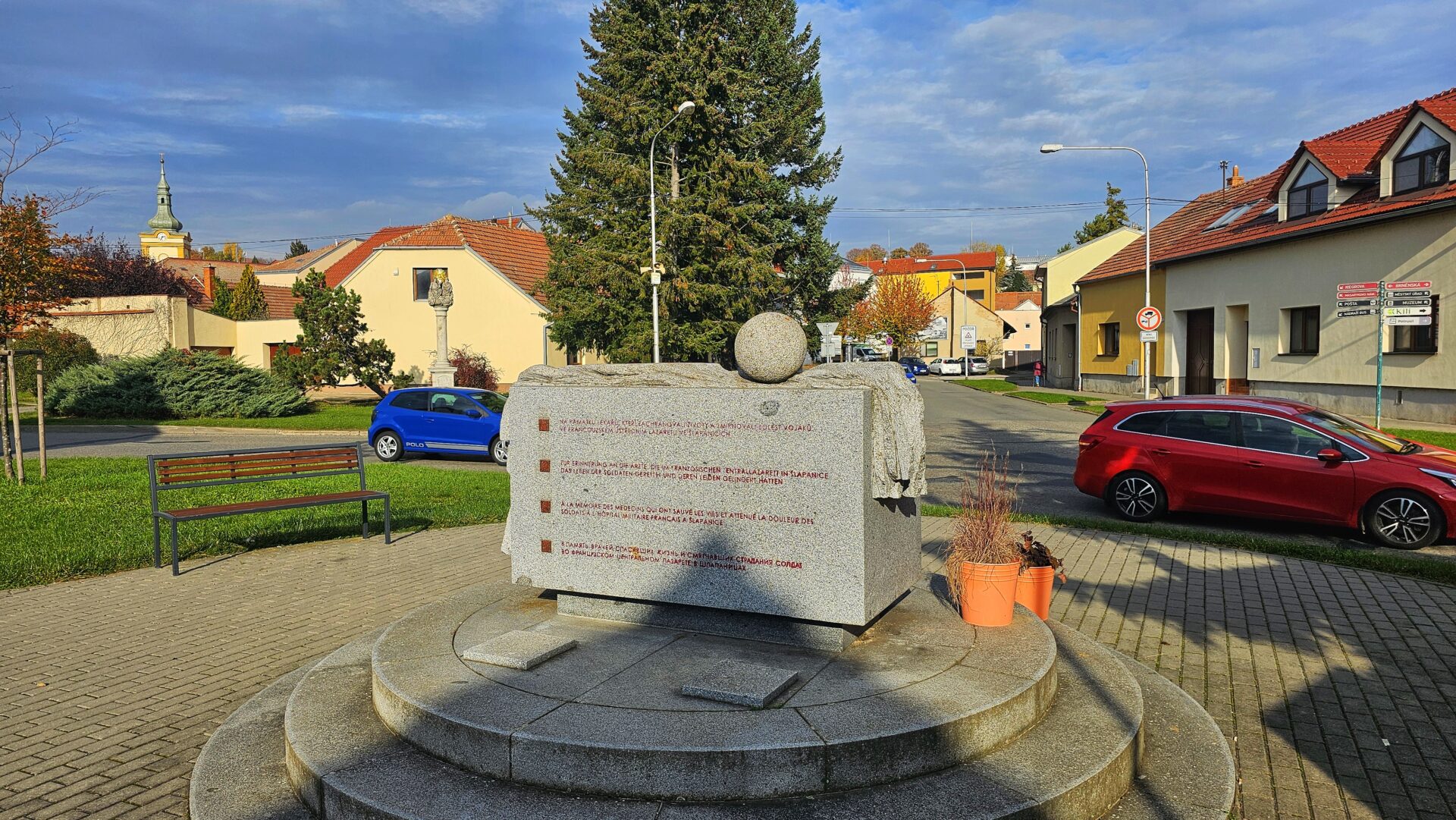
At the junction of Brněnská and Riegrova streets in Šlapanice is a 2005 work by sculptor Jaromír Blažek, installed for the bicentenary of the Battle of Austerlitz. A granite block represents an operating table, complemented by a stone drapery and a cannonball. The inscription reads: “In memory of the doctors who saved lives and eased the suffering of soldiers in the French central hospital in Šlapanice.”
Monument to Austrian artillerymen
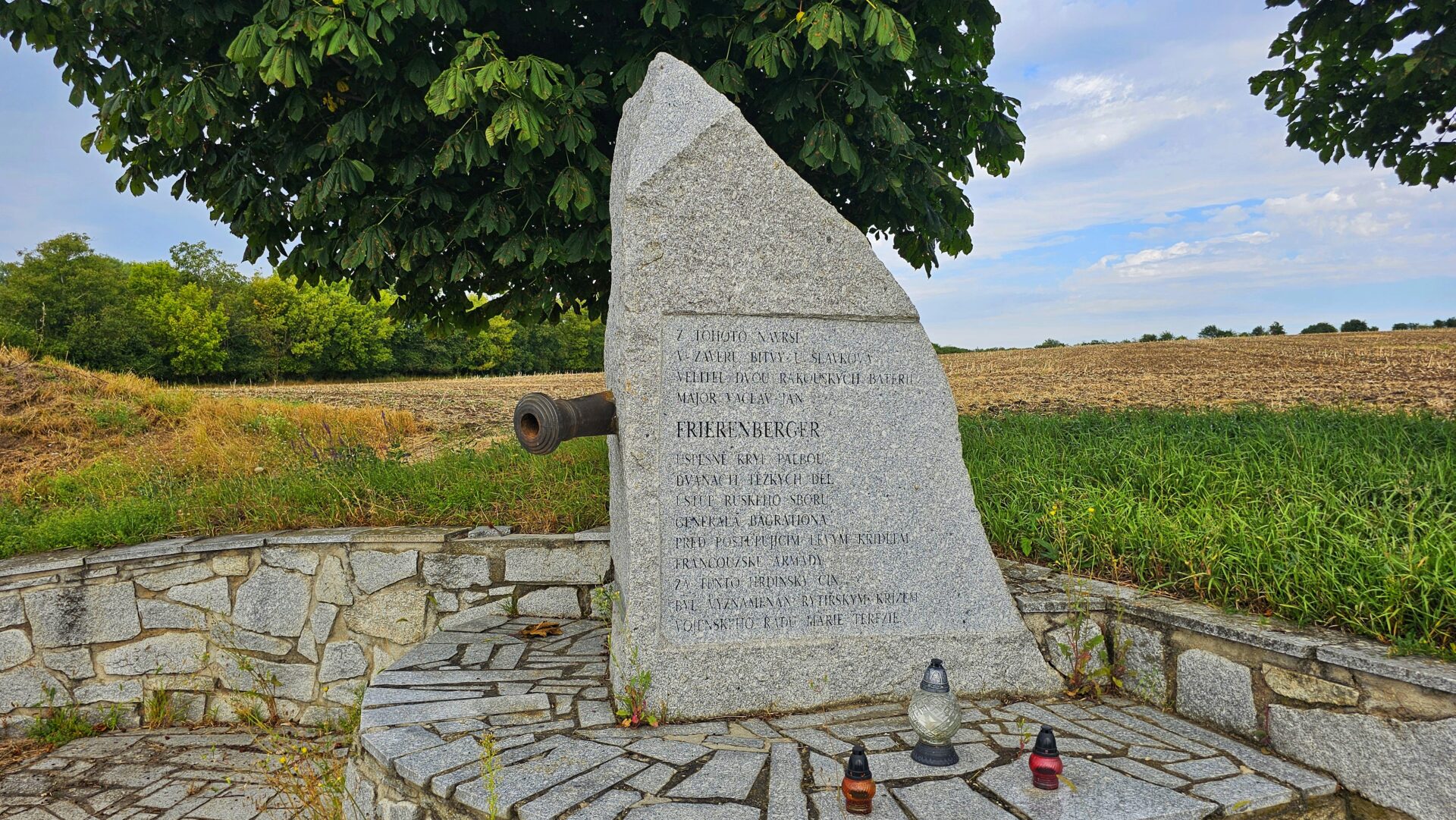
About 1.5 km east of the Old Post, beside Road 430 within the Velešovice cadaster, stands a monument to Austrian artillerymen. This striking stone memorial has the shape of a pyramid from which a cannon barrel projects.
It was built for the 190th anniversary (1995) by the historical artillery unit “Battery Austerlitz.” It honors two Austrian heavy artillery batteries which, under Václav Jan Frierenberger, covered the Russian retreat at the end of the Battle of Austerlitz.
Three Emperors Monument
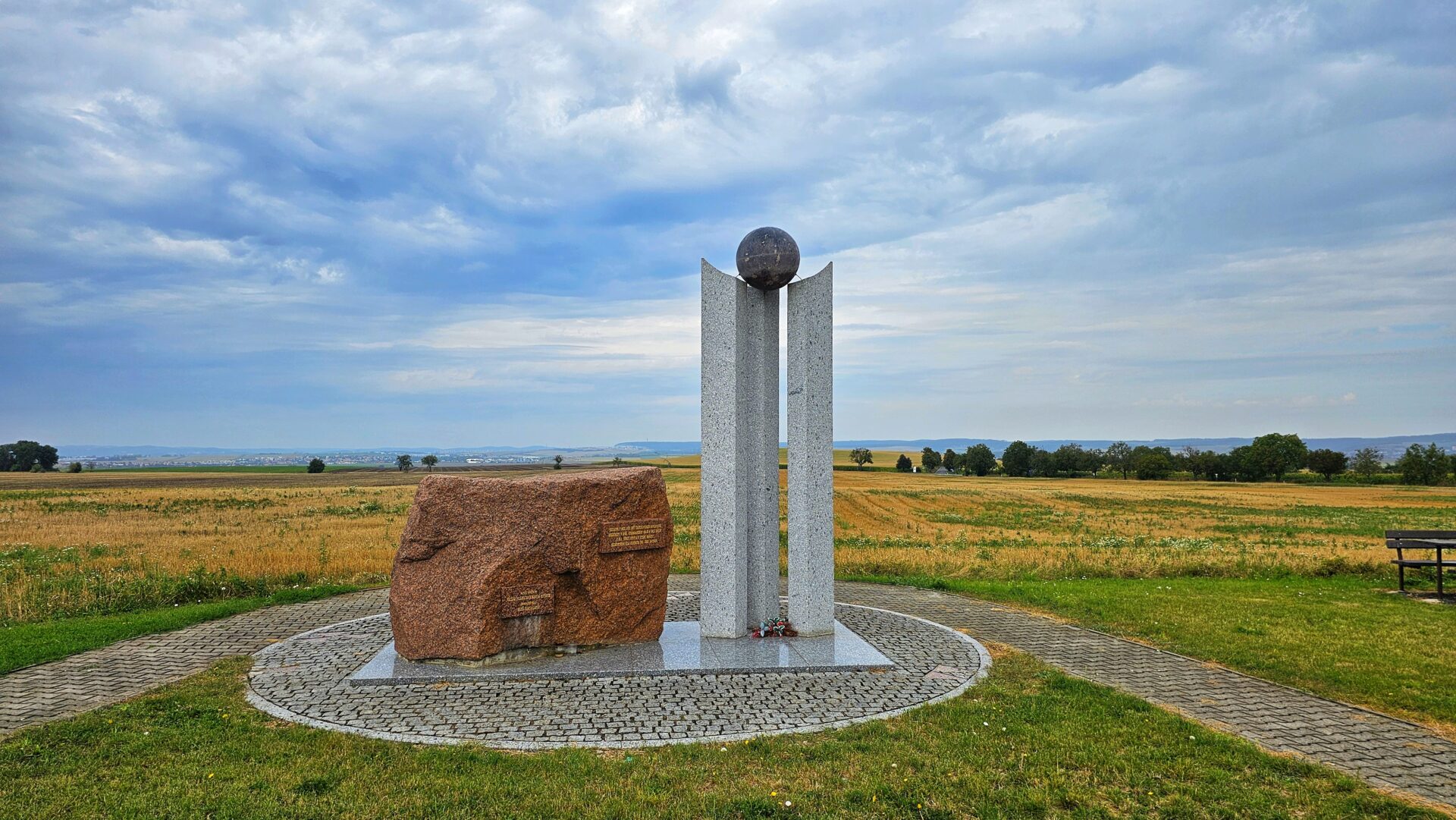
Within the Zbýšov cadaster, near the field road junction Prace–Křenovice and Blažovice–Zbýšov, stands the Three Emperors Monument. Its location and concept reflect that these places were, at different hours, traversed by the three rulers of European great powers: French Emperor Napoleon I, Russian Tsar Alexander I, and Austrian Emperor Francis I. Three columns represent the three monarchs, topped with the symbolic “Sun of Slavkov.”
The monument was erected by the Czechoslovak Napoleonic Society to a design by Václav Pyllmajer and Martin Hotárek, and unveiled in 2005 for the bicentenary of the Battle of Austerlitz.
Cast‑iron statue of an Austrian grenadier
The cast‑iron statue of an Austrian grenadier in full uniform and larger‑than‑life is one of three cast in the Strašice foundry in 1890 after a preserved 1756 model. Once part of the collections of the Technical Museum in Brno and the Historical Museum in Slavkov u Brna, it was moved to Rohlenka in 1988. Since 2017, it stands near the entrance to the château park in Slavkov u Brna.
Monument to the horses fallen in the Battle of Austerlitz
In 2010, behind the Old Post complex near Kovalovice, a monument was unveiled to the thousands of horses that perished in the battle, near the site of the great clash of French and Russian cavalry. The bronze statue of a life‑size horse symbolizes the multifaceted relationship between human and horse. The monument is by Nikos Armutidis.
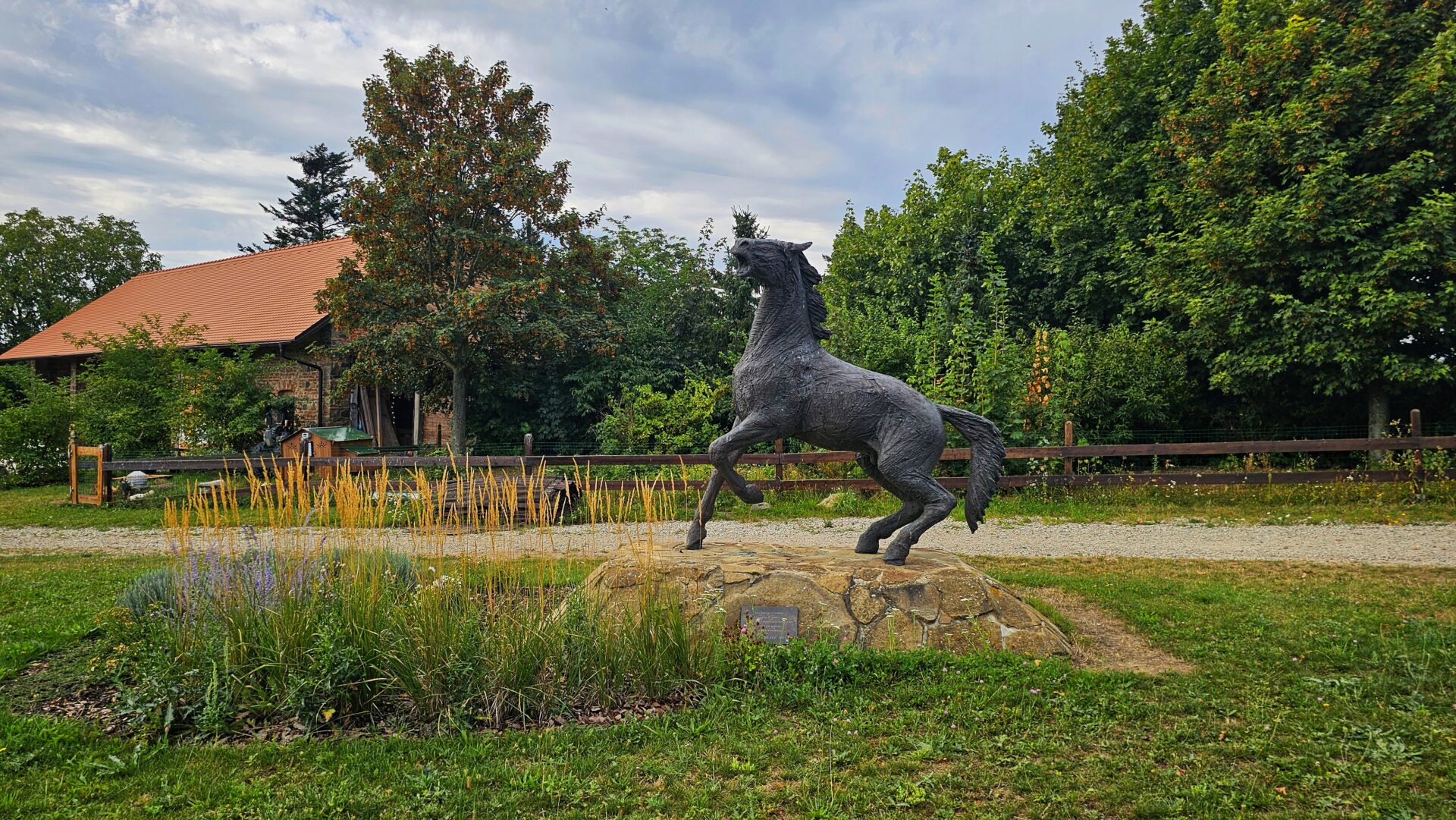
Incidentally, the Old Post historically served as a horse relay station for mail coaches on the Brno–Olomouc road — and horses are still kept there today.
Memorial to fallen horses
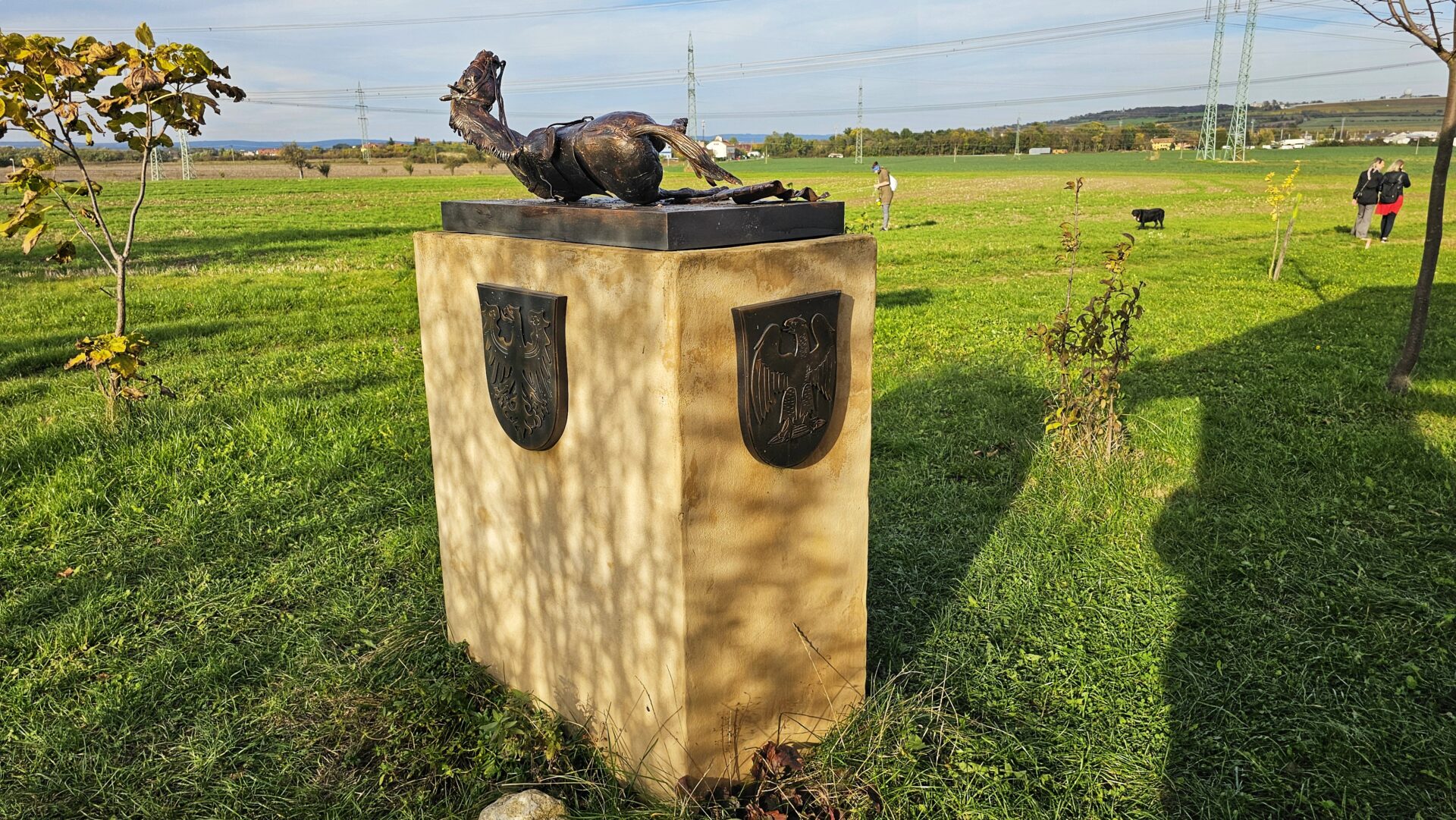
A newer memorial to fallen horses stands near Telnice by the roadside shrine Na Lopatě. This small yet poignant monument commemorates the horses that died during the battle. Unveiled in 2019, it is one of the stops on the local Historical Educational Trail Telnice, which guides you through the village’s 19th‑century history during the campaigns of Emperor Napoleon Bonaparte, covering both local life and notable buildings.
As you have read — and seen in the video — there are many memorials commemorating the Battle of Austerlitz (bitva u Slavkova) across the entire battlefield. While mapping them and gathering information, we discovered many fascinating places and stories previously unknown to us.
In 2025, it will be 220 years since the battle; it is quite possible a new memorial or monument will be added for this anniversary.
Pravious episodes in the series:
-
Battle of Austerlitz 1805 – A Walk Through the Battlefield I.
-
Battle of Austerlitz 1805 – A Walk Through the Battlefield II.
-
Battle of Austerlitz 1805 – A Walk Through the Battlefield III.
The video on our YouTube channel presents the most interesting monuments connected with the Battle of the Three Emperors. These memorials belong to a protected historical zone and can be explored on foot, by bicycle, or by car — thanks to educational trails and information panels spread throughout the area.
This YouTube video offers a fascinating look at one of the most significant battles of the Napoleonic Wars — the Battle of Austerlitz (the Battle of the Three Emperors). It traces the events before and during the battle, its key moments, and its impact on European history. Viewers will discover the places tied to it — such as Austerlitz Castle, Pratzen Heights, and Brno — as well as the major figures: Napoleon Bonaparte, Tsar Alexander I, Emperor Francis I, and General Kutuzov.